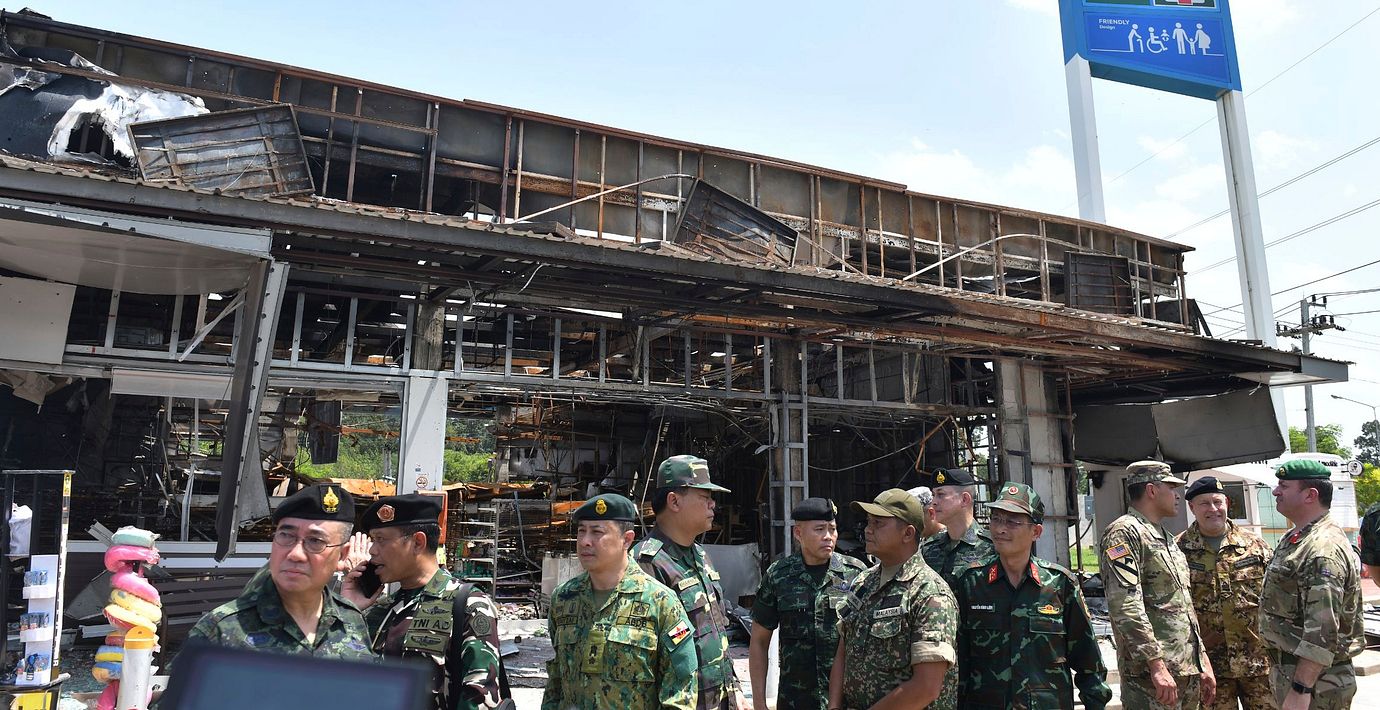
Bombningar mot elva bensinmackar i Thailand
Minst fyra personer har skadats i bombattacker mot elva bensinstationer i södra Thailand, uppger landets armé enligt AFP.
– Det skedde nästan samtidigt. Ett okänt antal män detonerade bomber som skadade bränslepumpar, säger Boonchauy Homyamyen, guvernör i regionen Narathiwat till lokala medier.
Enligt Thai PBS ska angriparna ha varit beväpnade, och i vissa fall tvingat anställda på bensinstationerna att lämna byggnaderna innan detonationerna.
Polisen säger sig inte veta vem som ligger bakom attackerna. Området har i över 20 år präglats av en konflikt mellan regeringen och muslimska rebeller som vill se ökad självständighet.
bakgrund
Konflikten i södra Thailand
Wikipedia (en)
The Southern Thailand insurgency (Thai: ความไม่สงบในชายแดนภาคใต้ของประเทศไทย; Malay: Pemberontakan di Selatan Thailand) is an ongoing conflict centered in southern Thailand. It originated in 1948 as a separatist insurgency in the historical Malay Patani Region, made up of the three southernmost provinces of Thailand and parts of a fourth, but has become more complex and increasingly violent since the early 2000s from drug cartels, oil smuggling networks, and sometimes pirate raids.
The former Sultanate of Pattani, which included the southern Thai provinces of Pattani (Patani), Yala (Jala), Narathiwat (Menara)—also known as the three Southern Border Provinces (SBP)—as well as neighbouring parts of Songkhla Province (Singgora), and the northeastern part of Malaysia (Kelantan), was conquered by the Kingdom of Siam in 1785 and, except for Kelantan, has been governed by Thailand ever since.
Although low-level separatist violence had occurred in the region for decades, the campaign escalated after 2001, with a recrudescence in 2004, and has occasionally spilled over into other provinces. Incidents blamed on southern insurgents have occurred in Bangkok and Phuket. In July 2005, Prime Minister Thaksin Shinawatra assumed wide-ranging emergency powers to deal with the southern violence, but the insurgency escalated further. On 19 September 2006, a military junta ousted Thaksin in a coup d'état. The junta implemented a major policy shift by replacing Thaksin's earlier approach with a campaign to win over the "hearts and minds" of the insurgents. Despite little progress in curbing the violence, the junta declared that security was improving and that peace would come to the region by 2008. By March 2008, however, the death toll surpassed 3,000. During the Democrat-led government of Abhisit Vejjajiva, Foreign Minister Kasit Piromya noted a "sense of optimism" and said that he was confident of bringing peace to the region in 2010. But by the end of 2010 insurgency-related violence had increased, confounding the government's optimism. Finally in March 2011, the government conceded that violence was increasing and could not be solved in a few months. Local leaders have persistently demanded at least a level of autonomy from Thailand for the Patani region and some of the separatist insurgent movements have made a series of prior demands before engaging in peace talks and negotiations. However, these groups have been largely sidelined by the Barisan Revolusi Nasional-Koordinasi (BRN-C), the group currently spearheading the insurgency. It sees no reason for negotiations and is against talks with other insurgent groups. The BRN-C has as its immediate aim to make southern Thailand ungovernable and it has largely been successful.
Estimates of the strength of the insurgency vary greatly. In 2004, General Pallop Pinmanee claimed that there were only 500 hardcore jihadists. Other estimates say there as many as 15,000 armed insurgents. Around 2004, some Thai analysts believed that foreign Islamic terrorist groups were infiltrating the area, and that foreign funds and arms were being brought in, though again, such claims were balanced by an equally large body of opinion suggesting this remains a distinctly local conflict. Over 6,500 people died and almost 12,000 were injured between 2004 and 2015 in a formerly ethnic separatist insurgency, which has currently been taken over by hard-line jihadists and pitted them against both the Thai-speaking Buddhist minority and local Muslims who have a moderate approach or who support the Thai government.
Omni är politiskt obundna och oberoende. Vi strävar efter att ge fler perspektiv på nyheterna. Har du frågor eller synpunkter kring vår rapportering? Kontakta redaktionen